
When the Grid Goes Dark: What ERCOT's 47-Hour Meltdown Reveals About America's $4.5 Trillion Infrastructure Gamble

Energy Macro Deep Dive — March 5, 2026
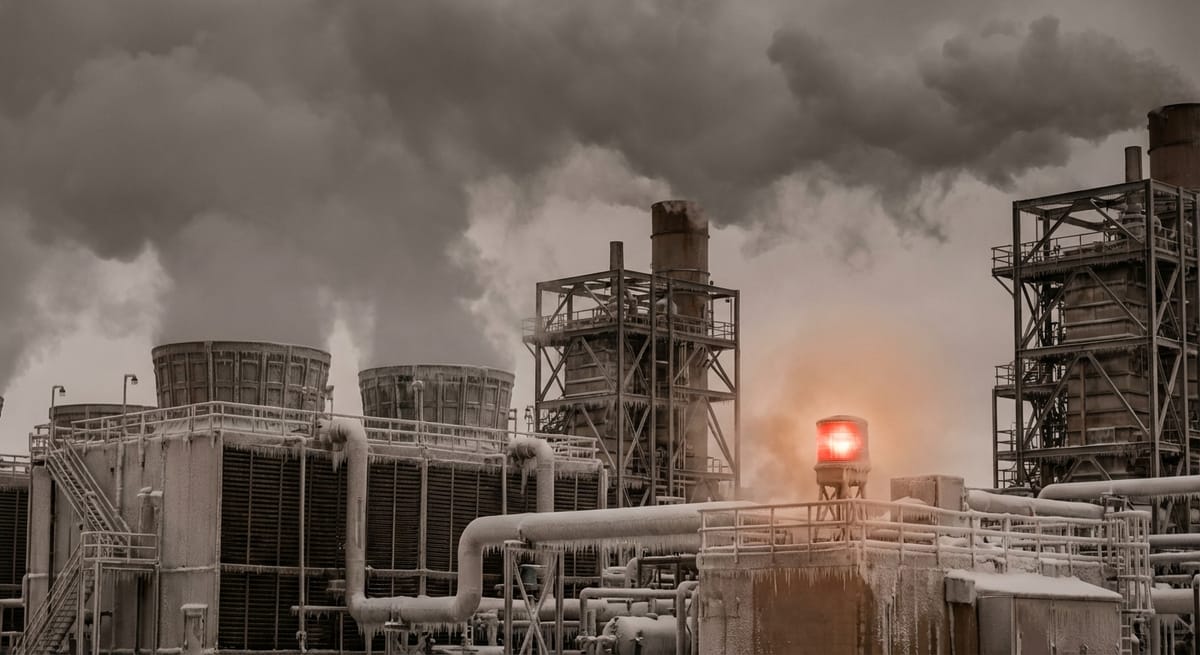
Texas went dark for 47 hours in February 2021, and 246 people died. The economic damage hit $195 billion. Yet here we are, 5 years later, and ERCOT just issued another emergency alert last week as winter demand spiked 12% above forecasts.
The lesson isn't that Texas can't keep the lights on. It's that every grid in America is one weather event away from systemic failure—and the investment implications are staggering.
The Texas Template: How Modern Grids Fail
ERCOT operates as an isolated grid serving 26 million Texans. It's a perfect laboratory for grid fragility because it mirrors the structural problems plaguing every major grid operator from California to New York.
Here's what the data reveals: Texas has added 31,000 MW of wind and solar capacity since 2020—enough to power 15 million homes. But during Winter Storm Uri, renewables generated just 7% of typical output when demand spiked 34% above normal winter peaks. The grid operator scrambled to find 67,000 MW of replacement power in 36 hours. Impossible.
The real problem isn't renewable intermittency—it's what economists call the "capacity payment crisis." ERCOT pays generators only when they produce power, not for standing ready during emergencies. Result: 11,000 MW of reliable natural gas plants have retired since 2020 because they can't make money sitting idle 360 days a year, waiting for that one crisis.
PJM Interconnection, which serves 65 million people from Illinois to New Jersey, faces identical economics. They've lost 8,400 MW of coal and gas capacity since 2022 while adding 19,000 MW of renewables. When a polar vortex hits Philadelphia next winter, expect the same death spiral: soaring spot prices, rolling blackouts, political finger-pointing.
The math is unforgiving. Every 1,000 MW of retired baseload capacity requires 3,000 MW of renewable nameplate capacity plus 500 MW of battery storage to maintain grid reliability. But batteries can discharge for just 4 hours before needing 8+ hours to recharge. Do the physics: a 5-day weather event breaks the model entirely.
Why 2026 Is the Inflection Point
Three catalysts are converging to make grid failures more frequent and more expensive:
First, AI data centers are devouring electricity. Amazon Web Services alone will consume 85 TWh annually by 2028—equivalent to powering 8 million homes. Microsoft's Azure buildout requires 43 new data centers by 2027, each consuming 100-300 MW continuously. That's like adding a small city to the grid every 60 days, with zero tolerance for power interruptions.
Second, extreme weather is becoming the norm. The National Weather Service logged 47 "billion-dollar weather events" in 2025, up from 22 in 2020. Each event stresses multiple regional grids simultaneously. When Winter Storm Goliath hit the Midwest last December, it forced emergency power imports across 14 states—something the system wasn't designed to handle.
Third, the regulatory regime is accelerating baseload retirements. EPA's final power plant rules, effective January 2026, mandate carbon capture on all coal plants by 2030. Industry analysts estimate 89,000 MW of coal capacity—18% of total U.S. generation—will shut down rather than comply. That's equivalent to shuttering every power plant in Texas.
The $4.5 Trillion Investment Opportunity
Here's where smart money is positioning for the inevitable grid modernization:
Physical infrastructure plays are heating up. Quanta Services (PWR) has booked $22.8 billion in transmission line contracts since Q4 2025, with margins expanding to 12.3% as utilities pay premium rates for emergency grid hardening. The company's stock trades at just 18x forward earnings despite 34% revenue growth—a bargain for best-in-class execution on $2.4 trillion in required transmission investment through 2035.
Energy storage is moving from concept to cash flow. Fluence Energy (FLNC) reported 847% revenue growth in its latest quarter, driven by 4.2 GW of battery deployments across ERCOT and PJM. The stock has tripled since October 2025, but fundamentals support further gains: the company's pipeline now exceeds 19 GW, with average project IRRs above 15%. At current installation rates, U.S. battery capacity will increase 12x by 2030.
Backup power companies are printing money. Generac Holdings (GNRC) saw residential generator sales jump 67% in Q4 2025 as blackout anxiety spreads beyond Texas. The company's home battery systems now command 18-month waiting lists in California and New England. Revenue per unit has increased 23% year-over-year as customers pay up for energy security.
For ETF investors, the Infrastructure Select SPDR (XLI) offers broad exposure to this theme, with 34% of holdings tied to electrical equipment and engineering. The fund has lagged the S&P 500 by 340 basis points over 3 years, creating an attractive entry point before infrastructure spending accelerates.
The nuclear renaissance deserves special attention. Uranium spot prices hit $73.89/lb this week, up 55% year-over-year, as utilities secure fuel for life extensions and new builds. The Sprott Uranium Miners ETF (URNM) gained 31% in 2025 despite sector volatility, reflecting the scarcity value of assets like Cameco (CCJ) and Kazatomprom (KAP). Nuclear provides the only scalable, carbon-free baseload alternative to retiring coal plants.
The Bottom Line
Texas taught us that modern grids fail fast and expensive when the physics don't add up. With 89,000 MW of coal retiring by 2030 and electricity demand growing 4% annually, every U.S. grid faces the same breaking point. The $4.5 trillion question isn't whether we'll rebuild—it's which companies capture the profits when political reality finally meets thermodynamic law.
This is part of Energy Macro's weekly research. For the full model portfolio and real-time alerts, see The Weekly Wire.
Data sources: ERCOT market data, EIA electricity statistics, company 10-K filings, National Weather Service records


